
Introduction
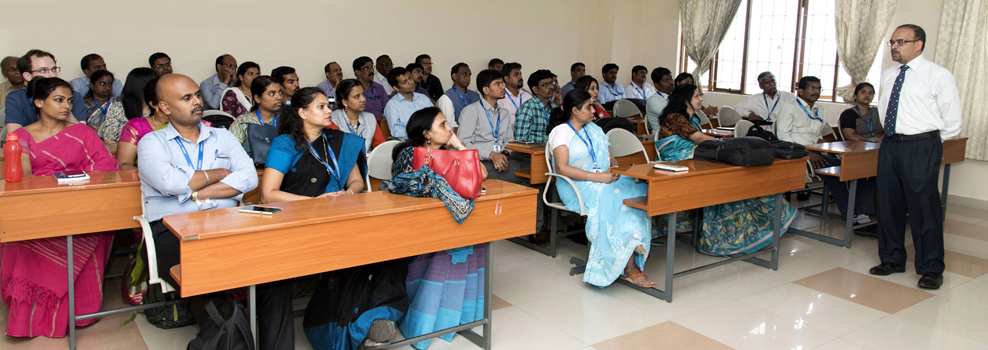
CHRIST (Deemed to be University) deems it essential to develop its Human Resources of Faculty and Staff to make them dynamic and growth oriented by creating a climate that can continuously identify, bring to surface, nurture and use the capabilities of people. In this regard, CHRIST had established an Academic Staff College (CUASC) for its own Faculty to provide Orientation and Refresher Courses and also to extend Quality Improvement Programmes (QIP).
Read More
CHRIST (Deemed to be University) deems it essential to develop its Human Resources of Faculty and Staff to make them dynamic and growth oriented by creating a climate that can continuously identify, bring to surface, nurture and use the capabilities of people. In this regard, CHRIST had established an Academic Staff College (CUASC) for its own Faculty to provide Orientation and Refresher Courses and also to extend Quality Improvement Programmes (QIP). CHRIST has also established specialised centres for the training of the human resources at the University in related organisational and functional areas. These were exclusive initiatives of CHRIST and have not been part of the UGC Academic Staff Colleges
CHRIST largely follows the guidelines issued by UGC and in order to adopt, synchronize and improve Human resource training, the Human Resource Development Centre (HRDC) was established in the year 2020. The Centre brings under its common umbrella the CUASC and all other Centres of CHRIST (collectively referred to as HRD Units) engaged in HRD initiatives.
The HRDC is empowered to assess the performance of the various HRD Units and to initiate Quality Improvement measures in their functional areas. The Centre will also review and advise on the performance of the HRD Units engaged in the training and management development of the Faculty and Staff of the University.
Objectives
-
The Centre will help its teaching and non- teaching staff (employees) to develop their personal and organizational skills, knowledge and abilities with reference to their respective role in the University. -
HRD shall endeavour to develop an organisational culture that will inculcate a healthy interpersonal relations among the employees, observation of protocol, self-motivation, quality in work execution and a sense of institutional belonging. -
HRD functions at CHRIST will be monitored by the Human Resource Development Centre (HRDC) and shall include job oriented training, career progression and advancement, effective performance enhancement, counseling and mentoring and organizational adaptation for all regular employees of the University. -
The HRDC in pursuance of the aforesaid general objectives of HRD shall focus on the following activities executed through dedicated HRD Units:
-
Organising outcome-based blended learning programmes (induction/ orientation/refresher courses and other professional development programs) for teachers and non-teaching Staff of the University. -
Organising programmes on theme-based topics like Academic leadership, Technology Enhanced Learning, Disaster Management, Gender Sensitization, IPR, Social Connect Programme and Learning Outcome Based Education including evaluation. -
Organising specially designed programmes in IT for new entrants as well as for in-service teachers and support staff.
-
While guiding and monitoring the activities of HRD Units the HRDC shall inter-alia consider:
-
Significance of education in general and higher education in particular, in the global and Indian contexts. -
Linkages between education and economic and socioeconomic and cultural development, with particular reference to the Indian polity. -
Requirement of basic skills of teaching at the university level to achieve goals of higher education with reference to latest developments in various subject disciplines. -
Role perception of teachers and support staff in theUniversity system with reference to the Institutional Vision and Mission