christ

Type of School Facility: Content

  • Report On Signing of MOU by Department of Life Sciences with Bionivid Technology Private Limited on September 4, 2018 ( Life Sciences )

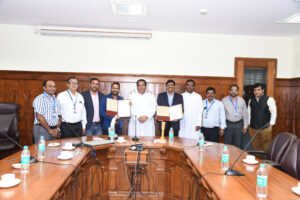
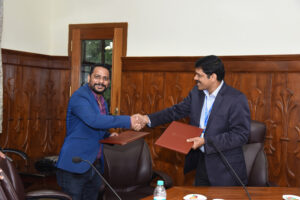
    To foster Industry-Academia collaboration, an MoU was signed between Bionivid Technology and CHRIST (Deemed to be University) on September 4, 2018 by Mr. Hitesh Goswami, Co-Founder – Bionivid Technology and Dr. Anil Pinto, Registrar, CHRIST (Deemed to be University) in the presence of Fr. Abraham (Pro VC), Fr. Jobi Xavier (CFO and HoD, Life Sciences), Dr. Surendra Kulkarni (Dean of Sciences and HoD, Chemistry) and faculty from Science Deanery. The primary aim of this partnership is to offer quality training and hands on experience to students in the area of Genomics BIG DATA analytics.

  • MoU (Computer Science)

    Signed MOU with Vivekanandha College of Arts and Sciences for Women (Autonomous), Tiruchengode, Namakkal, India

    Industrial Collaboration/MoU:

    1.Kritter Software Company,Banaglore. (Industrial Collaboration Agreement done)
    2. Code Cognitive Software Company, Trichy (Industrial Collaboration Agreement done)
    3. Midline,Software Company,Hyderabad. (Industrial Collaboration Agreement done).
    4. UNANU Software Company, USA and Chennai. (Industrial Collaboration Agreement done).
    5.Corestrate Software Company,Bangalore,(Industrial Collaboration Agreement Done).
    6.Mealtwater Software Company,Bangalore, (Industrial Collaboration Done).
    7.Infosys Software Company(SpringBoard),Bangalore.(Industrial Collaboration Done)
    8.Pirai Infotech, Software Company, Coimbatore. (Industrial Collaboration Done)
    9.Simplify Software Company, Bangalore. (Industrial Collaboration Done)
    10.Metaz Digital, Company, Bangalore.

  • Industry collaborations (Computer Science)

    CHRIST (Deemed to be University)
    Bengaluru-560029
    Consultancy Cell
    Sl.No Name of the Organization/Faculty Project Title/Completed Academic Year
    1 Naval Events,Erode./ Web Site 2017-18
    Dr.Kirubanand and Dr.Vinay
    2 KRITTER Software Technology, Bangalore/ Ad Tech 2018-19
    Dr.Kirubanand
    3 AKN exports, Erode, Tamilnadu/ Web Development 2018-19
    Dr.Kirubanand and Dr.Vinay
    3 St.Anne’s Congregation, Chennai/ e-SSA – Information system 2018-19
    Dr.Arokia paul rajan
    4 Old Age Home, Spain/ Web Development 2018-19
    Dr.Arokia paul rajan
    5  PJP College, Pondicherry/ Training on Edcuation Tools 2018-19
    Dr.Arokia paul rajan.Dr.Vinay
    6 Avinashilingam University, Coimbatore Event Training Session 2018-19
    Dr.Vinay and Dr.Beaulah
    7 KRITTER Software Technology, Bangalore/ Ad Tech 2019-20
    Dr.Kirubanand
    8 Code Cognitive, Trichy/ R&D Project 2019-20
    Dr.Smantha,Dr.Nismon and Dr.Biswas
    9 CHRIST (Deemed to be University) Hands on Training in Hadoop 2019-20
    Department of Computer Science
    Bangalore.
    Dr.Kirubanand and Dr.Peter augustine
    10 Title of Project:  Quantum Cryptography, Funding Agencies: Code Cognitive, India, . Research Project Completed 2019-20
    Dr.Nismon,Dr.Samantha and Dr.Biswas
    11 Midline,Software Company, Application Project 2020-21
    Hyderabad
                             Dr.Shoney Sebestain
    12 Title of Project:  Graph Theory and Computational Intelligence. Dr.Samantha Research Project Completed 2021-22
    13 Title of Project:  Cellular IoT in VANET. Duration: 2 months.  Status: Completed. Role: PI. Dr Samantha. Research Project Completed 2021-22
    14 Title of Project:  Wireless sensor network, Dr Samantha Dr Biswas Research Project Completed 2021-22
    15 Title of Project:  Image Processing, . Role: PI Research Project Completed 2021-22
    Dr.Samantha
    16 UNANU Software Technologies,Chennai Truck Optimization 2022-23
    (Dr.V.B.Kirubanand, Dr.T.Senthilnathan,Dr.Uma SRM) (on going)
    17 Shalom Infotech, Trichy, Dr.V.B.Kirubanand, Ms.Dhamini Online Bidding Banana Application. (Submitted) 2022-23
    18  Sri Sai Constructions, Coimbatore, Dr.V.B.Kirubanand, Ms. Dhamini Web Site Development(On Going) 2022-23
    19 Shankara College,Coimbatore, Dr.V.B.Kirubanand, Dr.Sandeep,Dr.Arulkumar Training on Cyber Security, Completed 2022-23
    20 Shankara College,Coimbatore, Dr.V.B.Kirubanand, Dr.Sandeep,Dr.Arulkumar,Dr.Cecil Training on Cyber Security, held on August 27,22 2022-23
    21 Futurama Industry 4.0- Block Survey Company, Bangalore. Training program on Industry 4.0 2022-23
    22 Training program: Dr.V.B.Kirubanand,Dr.Chandra,DrRajesh khanna,Dr.Vaidheji,Dr.Reshmi,Dr Somnath,Dr Cecil,Dr.Kavitha,Dr.Suresh, Training program on Data Engineering and Security 2022-23
    23 AI Project: Dr Asokimmanuel and Dr.Rajesh Khanna(On Going Project) AI Project-Indo Korean, CHRIST 2023-24
    24 Virtual Reality Authoring Software,Catholic University of Applied science, North Rhine-Westphalia.(Dr.Suresh and Kengeri Campus) On Going 2023-24
    25 An effective Disaster Recovery frame work to enhance flood resilience by providing longer term connectivity using mobile adhoc networks, ICSSR, Karnataka.(Dr.Nismon,Dr Cecil,Dr Suresh) On Going 2023-24
    26 Safe City Project( Dr. Manjunath and Dr.Ashok Immanuel On Going 2023-24
  • Research (physics and electronics)

    Research Facilities :

    Research Focus Areas :

    Department Project and Funding :

  • Research, Consultancy and Extension (Mathematics)

    Research in emerging areas such as Fluid Mechanics, Graph Theory, Differential Geometry, Number theory, Operation Research, Regression Analysis and Time series and forecasting techniques is a significant feature of the department. Added to that, faculty is engaged in collaborative research with eminent scholars from other universities across the world. There have been 4 minor projects of Rs. 60,000 each and two major projects of worth of Rs. 20 lakhs have been funded by the University. Faculty has been very active in publishing their research findings in the form of publications, with more than 230 publications in reputed national/international journals. All together, there have been more than 80 presentations from faculty members. 7 National level conferences, 1 International level conference and 7 Collaborative workshops with three Science Academies have been organized by the department. Faculty members are resource persons, empanelled guides and members of various professional bodies. Statistical consultancy is also offered by the department.

    • Dr S Pranesh has h-index and i10-index of 9 each according to Google scholar. His name is also reflected in the 8th edition of Who’s Who in Science and Engineering.

    • Dr B Mahanthesh has h-index 16 and i10-index 21 along with more than 750 citations according to Google scholar. He also has total of 361 citations from 43 documents according to the Scopus.

    • Dr N K Sudev has h-index 10 and i10-index 13 with more than 430 total citations according to Google scholar.  He also has 13 documents in Scopus.

    • Dr Fr Joseph Varghese has more than 2500 Research Gate reads for his research.

    • Every Wednesday (Research day), the faculty members are made free from regular classes to intensify the research work. Department also regularly conducts research meeting for instance, every third Sunday research meeting has been held past three years and every second Saturday discussion of graph theory research work has been held from this academic year for faculty, students including external recourse persons.

  • Research Ethics Guidelines (Mathematics)

    General guidelines for Research Ethics are as follows:
    1. Research must not cause harm to the participants in particular and to people in general.
    2. Research should as far as possible make a positive contribution towards the welfare of people.
    3. Researchers have a right , as well as a responsibility, to refrain from undertaking or continue undertaking any research that contravenes ethical guidelines, violates the integrity of research and/or compromises their autonomy in research, including design methodology, analysis and interpretation of findings and publication. If they  feel that their rights are being violated, or that the study is unethical, they should make all possible efforts at making corrections. In the event of failure of remedial measures they should exercise their right to terminate the study or to opt out of it.
    4. Research must respect and protect the rights and dignity of participants.
    5. The benefits and risks of research should be fairly distributed among people.
    6. All information and records provided by participants or obtained directly or indirectly on/about the participants are confidential. For revealing or sharing any information that may identify participants, permission of the participants is essential.
    7. All research must take adequate precautions towards minimizing and mitigating risks if any involved in the research process or in the delivery of its output.
    8. The relationship within the research team, including student and junior members, should be based on the principle of non-exploitation.
    9. Researchers have a responsibility towards the interest of those involved in or affected by their own work. They should make reasonable efforts to anticipate and to guard against possible misuse and undesirable or harmful consequences of research.
    10. Researchers should take reasonable corrective steps when they come across misuse or misrepresentation of their own work.
    11. Contribution of each member of the research team should be properly acknowledged.
    12. The conduct of research must be fair, honest and transparent. It is desirable that the researchers are amenable to social and financial review of their research.
    13. Researchers must ensure respect, protection and promotion of rights of participants. Criteria for the selection of participants of research should be fair, besides being scientific.
    14. The principal researchers should delegate to the juniors, assistants, students and trainees only those responsibilities that they are reasonably capable of performing on the basis of their education, training or experience, either independently or under supervision.
    15. All members of the team on a research project have a right to know and document all aspects of research including ownership of data. This will also apply to the participation of students doing their own research in a project team.

  • Research Code of Ethics (Mathematics)

    CHRIST (Deemed to be University), Bengaluru
    Department of Mathematics
    Research Code of Ethics

    Research and teaching form the backbone of Department of Mathematics. Accordingly, Department of Mathematics assumed a responsive role in order to promote academic research in diversified disciplines in Mathematics through the establishment of Research Development Cell. The Department of Mathematics provides faculty members, post graduate students and M Phil and Ph D scholars an opportunity to further deliberate and expand their ideas and views through projects at PG level, paper publications in refereed journals, participation and presentations in National/International conferences. The Research Development cell has the following specific objectives;

    • To promote and facilitate advanced research among faculty members of the Department.
    • To serve as a resource center providing professional guidance and technical support.
    • To carry out independent research of significance on topics of academic and professional interest.
    • To develop and provide relevant data base support to faculty members and post graduate students pursuing doctoral research.
    • To identify research areas and specify research topics of academic and practical significance.
    • To develop & promote Consultancy Projects for application of knowledge for the advantage of the end users.
    • To facilitate the review of reports submitted by the research scholars
    • To organize such of the activities which directly or indirectly facilitate the research and consultancy activities

    The activities of Research Development Cell are:

    • bi-annual reviews with external experts,
    • presentations at seminars/conferences,
    • involvement/engagement of students,
    • discussion with colleagues,
    • interaction with experts
    • Involvement of departmental/deanery colleagues in projects.

    Research Development Cell comprises of four members head of Department, Coordinator for PG programs and two senior researchers. They represent three major areas of Mathematics research namely, Fluid Mechanics, Graph Theory and Riemannian Geometry. RDC committee will have regular meetings (once in a semester) to enhance research. Sub-committees shall be formed to look into various aspects of research in postgraduate/M Phil/Ph D curriculum. The recommendations of subcommittee shall be validated in the Department meeting and CDC shall forward it for final approval in BOS. The department of Mathematics follows Institution policy of code of ethics.

    Policy

    The department will encourage publication of all material outputs of its Researchers irrespective of whether they support or contradict the Research outcome(s). There shall be adequate and effective mechanism set by department to ensure regular check on the compliance of the prescribed codes and guidelines throughout the Research process from the start till the delivery of its final output.

    Regulations

    1. The entire research process at the department including the outputs thereof in the form of publications, research reports(Minor and Major research projects, Monographs and working papers), Academic and consultancy research, formal and informal research programs and any such research activities will be covered under this policy and Regulation which will apply to all approved Researchers at the university including but not limited to University teachers, Staffs, students, Post Doctoral Fellows and Emeritus Fellows.
    2. Externally funded research projects shall be additionally guided by specific instructions if any of the concerned funding agency as long as they do not contradict with the provisions contained in this regulation.
    3. Code of Research conduct and the research ethics herein stated are inter-related and complementing to each other(may be overlapping as well) and hence must be applied carefully with due regard to the research problem. These are not administrative rules and therefore the conscience of researchers may be the best guide to ensure that conduct of research is not entirely left to the discretion of individual researchers while  addressing the ethical dilemmas that may crop up.

    1. Everyone involved in research (Sponsors, Investigators, Associates, assistants,Supervisors and any others generally referred to herein individually and collectively asresearchers) in the Department owes a duty of accountability to society, to their profession, to the university, to all participants in the research and to its funding agencies. Hence no one shall embark on any Research Activity without acquiring adequate
    theoretical and practical knowledge about the process and conduct of research.
    2. Researchers should undertake only such research that according to their understanding will be useful to society or for the furtherance of knowledge on the subject.
    3. Researchers must accept full responsibility for their research conduct and for the activities of all persons involved under their direction or supervision.
    4. Researchers must be honest and lawful in respect of their own actions in research and in their responses to the actions of other researchers. This applies to the whole range of research work, outputs and deliverables, including applying for funding, research design, generating and analyzing data, publishing results, and acknowledging the direct and indirect contribution of colleagues. Collaborators and others.
    5. Any Research must have a clearly defined objective and must be done meaningfully with full adherence to quality aspects. Research for research sake without creation of new knowledge or new dimension to existing knowledge will be considered unsatisfactory with reference to this code.
    6. Researchers must encourage peer review as an essential part of every research endeavor and must take into consideration all valid comments thereof at different stages of research process may be deemed relevant and appropriate. However the reviewer chosen must be able to do the task objectively, impartially and constructively.
    7. Researchers must ensure integrity of financial management of research project to provide the optimum value for the public or private funding agencies with appropriate quality standards, as well as timely delivery of any scheduled tangible outcomes.
    8. Researchers must ensure that all personal records of research progress, including books, are maintained to the recommended or required standards, and that the falsification of results does not occur.
    9. All research data must be in a durable form with appropriate references. All such data must be retained intact for a period of at least seven years from the date of any publication which is based upon them. Data should be there in their original form, i.e, tapes/discs, etc., and should be deleted and reused, but kept securely as per approved procedure as may be prescribed be the center for research of the university. These procedures must be made known to and compiled by all the members of the research team.
    10. Researchers must ensure that the participants are allowed to participate voluntarily without any fear or favour and absolutely free from coercion in an environment of least harm or risk to all living beings and to property.

  • Research (Mathematics)

    The Department of Mathematics focuses on high-quality research and has implemented successful research practices to promote research-based teaching-learning and knowledge production.
    The department is active in research, primarily in the areas of Fluid Mechanics, Graph Theory, Differential Geometry and Mathematical Modeling. Our faculty members are well established and well recognized researchers in their areas of specialization. The presence of emeritus professors nurtures the ambience for quality that facilitates constructive discussions, fruitful deliberations and critical evaluation of the projects that help the aspiring researchers to produce quality output.
    Good number of faculty have working collaboration with eminent researchers from countries spread across the continents leading to high-quality, high-impact collaborative research papers, book chapters and books. The h-index of about one third of the faculty are above 10 and have published more than 70 articles with good number of citations. They also contribute to the knowledge economy by serving in the editorial boards, reviewing articles and disseminating their knowledge as resource persons at several national and international conferences.
    A total of 21 candidates have secured their doctoral degree and 53 doctoral students are pursuing their studies in the department. To ensure good quality of research undertaken by students, a minimum of two Scopus/Web of Science indexed publications are made mandatory for the submission of the doctoral thesis. Bi-annual assessment of progress in research and nature of research further ensures that the best standard is maintained. Research projects are mandatory at the postgraduate level and ample opportunities are provided for doing research-based projects at the undergraduate level also.